

Before we start with today’s story, I just wanted to say the work here at Independent Thought is not funded by billionaires or corporations. It’s funded by you, the readers of our account.
Your support is what allows me to continue to bring you the news. Please consider becoming a paid subscriber today for access to our exclusive paid-members only posts, and to support our work. Thank you.
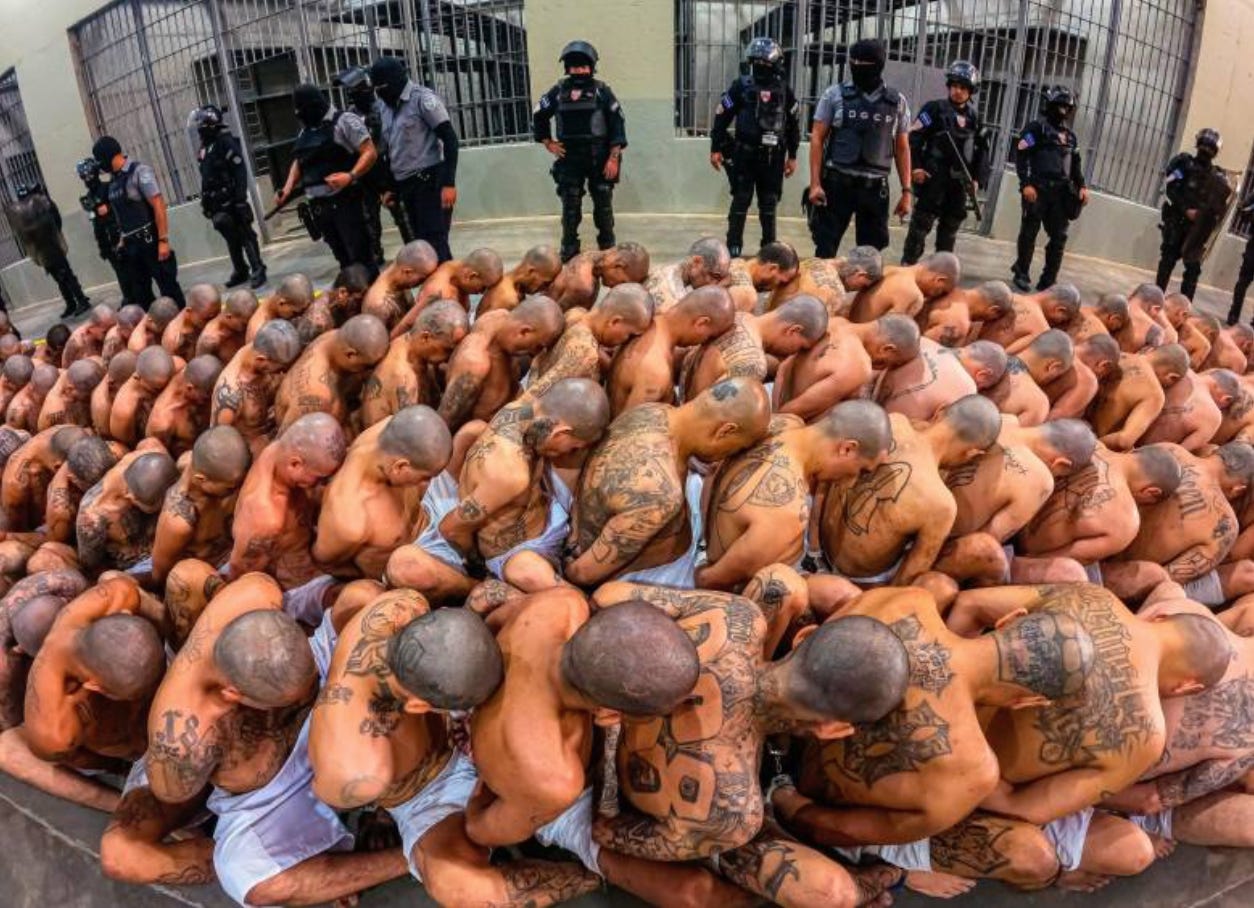
Following our post yesterday about Trump considering sending American citizens to El Salvadoran prisons, I thought it was important to include more information about why exactly these prisons need to be looked at differently than what you might imagine a traditional prison to look like.
If you didn’t check out our post from yesterday, here’s the link if you want to refer back to it ⬇️
Trump Discusses Sending American Citizens To El Salvadoran Prisons - Twice In The Last Week

Independent Thought is a reader-supported publication. To receive new posts and support my work, consider becoming a free or paid subscriber.
El Salvador’s President doesn’t shy away from the reputation of these prisons either.
On X, Nayib Bukele has described himself as the “CEO of El Salvador,” “the coolest dictator in the world,” or “Philosopher King.” Among his humorous self-descriptions, he could also call himself “ the jailer of El Salvador,” which would be an introduction as ironic as it is literal. — Source
While being incarcerated is already something akin to torture, these particular prisons, in the nation of El Salvador, have been uniquely tagged by the Human Rights Watch Organization.
Below, I’m going to list some key details about what they found while investigating those prisons:
Individuals deported pursuant to the 1789 Alien Enemies Act have been sent to the Center for Terrorism Confinement, the Centro de Confinamiento del Terrorismo (CECOT) in Tecoluca, El Salvador. The prison was first announced for a capacity of 20,000 detainees. The Salvadoran government later doubled its reported capacity, to 40,000. As Human Rights Watch explained to the UN Human Rights Committee in July 2024, the population size raises concerns that prison authorities will not be able to provide individualized treatment to detainees, thereby contravening the UN Standard Minimum Rules for the Treatment of Prisoners.
People held in CECOT, as well as in other prisons in El Salvador, are denied communication with their relatives and lawyers, and only appear before courts in online hearings, often in groups of several hundred detainees at the same time. The Salvadoran government has described people held in CECOT as “terrorists,” and has said that they “will never leave.” Human Rights Watch is not aware of any detainees who have been released from that prison. The government of El Salvador denies human rights groups access to its prisons and has only allowed journalists and social media influencers to visit CECOT under highly controlled circumstances. In videos produced during these visits, Salvadoran authorities are seen saying that prisoners only “leave the cell for 30 minutes a day” and that some are held in solitary confinement cells, which are completely dark.
In July 2024, Human Rights Watch published a report on abuses committed against children during the state of emergency, titled “Your Child Does Not Exist Here.” Over 3,300 children have been detained, many without any ties to gang activity or criminal organizations. Human Rights Watch documented 66 cases of children subjected to torture, ill-treatment and appalling conditions, including at times extreme overcrowding, unhygienic conditions, and inadequate access to food and medical care while in custody. In February, the Legislative Assembly approved a law ordering the transfer of children detained for organized crime offenses to the country’s adult prison system, exposing them to a heightened risk of abuse and violating international juvenile justice standards.
For “We Can Arrest Anyone,” and in “Your Child Does Not Exist Here,” Human Rights Watch has interviewed more than 30 people released from El Salvador’s prisons, including children, and dozens of people who have relatives in jail. These interviews were conducted in person in several states in El Salvador or by telephone and corroborated by additional research and media reports. One of the people we spoke with was an 18-year-old construction worker who said that police beat prison newcomers with batons for an hour. He said that when he denied being a gang member, they sent him to a dark basement cell with 320 detainees, where prison guards and other detainees beat him every day.
Another detainee held in prison in June 2022 described being sent to what he described as a “punishment cell.” He said officers moved him and others there to “make room for other detainees.” The new cell was constantly dark, detainees had to sleep standing due to overcrowding, and there was no regular access to drinking water.
A third detainee we interviewed was held for two days in a police lock-up with capacity for 25 people, but he said that when he arrived, there were over 75 prisoners. He slept on the floor next to “the bathroom,” a hole in the ground that smelled “terrible.” He was sent in a group of other prisoners to Izalco prison on the third day, where they were ordered the group to take off their clothes. They were forced to kneel on the ground naked looking downwards for four hours in front of the prison’s gate. Guards took the group to a room with five barrels full of water with ice, he said. Fifteen guards forced him and others to go into the barrels for around two hours in total, as they questioned them. The detainee was forced into a barrel “around 30 times,” and was kept there for about a minute each time. Guards forced his head under water so he could not breathe. “I felt I was drowning,” he said. Guards repeatedly insulted them, calling them “dogs” and “scum” and saying they would “pay for what [they] had done.”
For “We Can Arrest Anyone,” Human Rights Watch and Cristosal gathered evidence of over 240 cases of people detained in prisons in El Salvador with underlying health conditions, including diabetes, recent history of stroke, and meningitis. Former detainees often describe filthy and disease-ridden prisons. Doctors who visited detention sites told us that tuberculosis, fungal infections, scabies, severe malnutrition and chronic digestive issues were common.
In one case, a person who died in custody was buried in a mass grave, without the family's knowledge. This practice could amount to an enforced disappearance if authorities intentionally concealed the fate or whereabouts of the detainee.
In a separate Human Rights Watch report from February 2020, titled “Deported to Danger,” Human Rights Watch investigated and reported on the conditions in Salvadoran prisons experienced by Salvadoran nationals deported by the United States.[3] In interviews with deportees and their relatives or friends, we collected accounts of three male deportees from the United States who said they were beaten by police or soldiers during arrest, followed by beatings during their time in custody, which lasted between three days to over a year. During their time in prison, two of these individuals reported being kicked in the face and testicles. A third man described being kicked by guards in his neck and abdomen, after which he sustained injuries requiring an operation for a ruptured pancreas and spleen, month-long hospitalization, and 60 days of post-release treatment.
Out of the estimated 350 detainees who have died in El Salvador’s prisons, we documented 11 of these cases in detail in “We Can Arrest Anyone”, based on interviews with victims’ relatives, medical records, analysis by forensic experts, and other evidence. In at least four of the eleven cases, photographs of the bodies show bruises. Members of the Independent Forensic Expert Group (IFEG) of the International Rehabilitation Council for Torture Victims (IRCT), who reviewed the photos and other evidence in two of the cases, told Human Rights Watch and Cristosal that the deaths were “suspicious” given that the bodies “present multiple lesions that show trauma that could have been caused by torture or ill-treatment that might have contributed to their deaths while in custody.”
Source - Human Rights Watch
Please share this information with others! It’s important that more people understand what’s happening in these torture chambers.
I Couldn’t Stop Talking About This Story Yesterday
After making my post here on Substack, I took to my account on Instagram & posted this on my story ⬇️
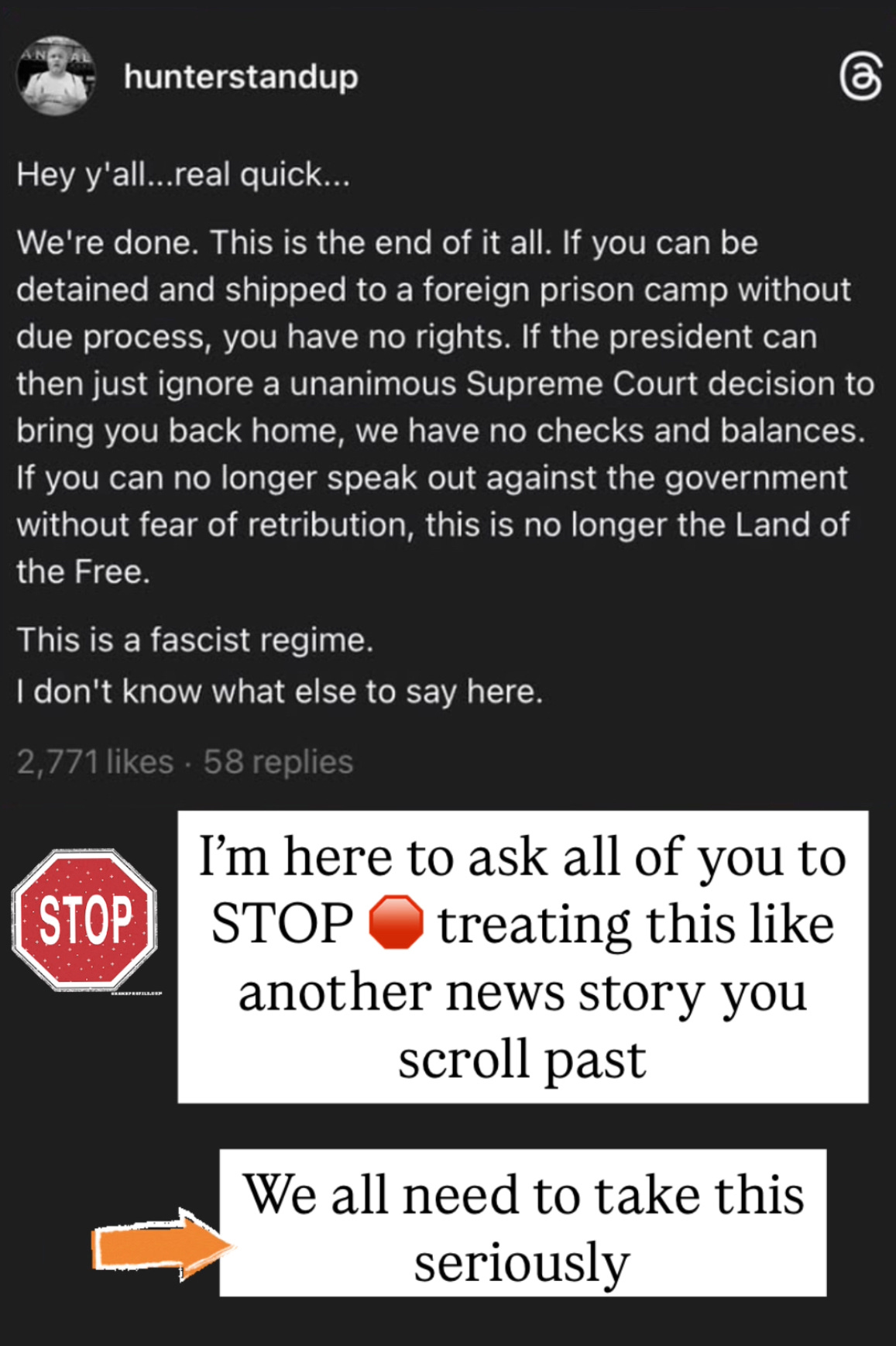
I know some people recoil a bit when they feel like they’re being “called out” while reading something, but after doing this work for 5 years, I don’t know that I’ve ever been as alarmed as I currently am.
Trump is in real time:
Stripping Constitutional rights away from people
Disappearing them off the streets
Sending them to torture prisons in another country
Where they will likely never leave
Resisting his own conservative Supreme Court’s order to return these people
While no one seems to have the power to stop him
Now I ask you, as you’re reading this on a Tuesday morning or afternoon, at what point (if you haven’t already) do we stop treating this like “just another story?”
I grant you, that we’re all a bit exhausted & to a degree, you cannot get worked up for every story regarding Trump, for sanity’s sake. However, let’s just examine the contents of this particular story again & then tell me that this isn’t different from the others?
And if for some reason, the idea of Trump sending “criminals” to this place doesn’t bother you (which would be incredible after the conditions that were listed above), please remember this is Trump we’re talking about…someone who wants to criminalize speech that he doesn’t like.
How long until it’s illegal to say things he doesn’t like?
What once felt hyperbolic, all of sudden, no longer does. If he can violate the constitution & ignore the Supreme Court, what’s to stop him from going further?
Are any of us safe?
Final Thoughts
I honestly do not like the idea of leaving this conversation in such a dark place, so I’m going to share with you what I plan to do next.
I’ll be reaching out to my contacts over the next handful of days & seeing if I can sit down with folks who are better equipped to have this conversation, than I am.
I’ll refrain from naming names in the moment, because I’m not sure if they have time, but I have a couple people in mind who are more familiar with legal matters like these ones, & hopefully I can have them on for a conversation on Substack live this week, or early next week.
While I’m asking everyone to exercise extreme caution regarding this story & to take this more seriously, I’m also hoping that this doesn’t drive folks into despair.
Yes, we are facing something unprecedented, but we are more likely to overcome it, if we stand together, in a united resistance.
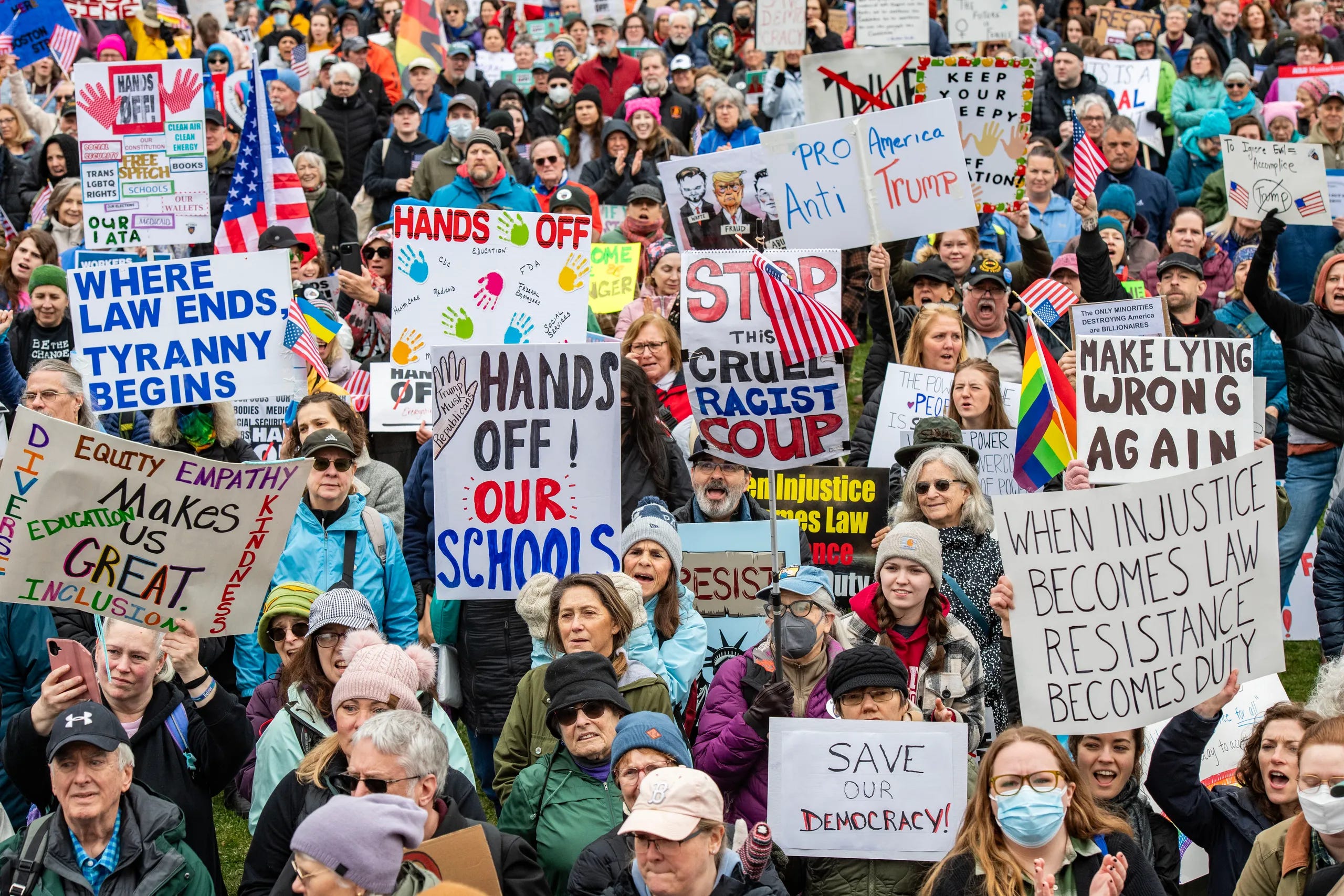
There will be nationwide protests this week.
Find yourself at one.
Build some new community.
Make connections & plans.
We’re stronger together.
Together, we will find a way to overcome the Trump regime.
Until next time,
Desmond

If you haven’t already, please come join us on Instagram & help us hit 32,000 followers.

Thank you for being a member of the Independent Thought Substack.
As of today, we have 12,904 readers of this publication!
Welcome to all of our new readers & thank you for being a part of our growing newsletter!
If you appreciated this post, please share it on social media or with a friend.
If you liked this post, please click the heart ❤️ button & 🔄 button. This helps Independent Thought get recommended more within Substack.
This newsletter is 100% reader-funded. Please become a paid subscriber to support our work.
These are concentration camps. No human should ever be treated this way. It takes a very evil and sick mind to order these types of treatment and to carry them out,
Now is the time to act. This man must be impeached.
Reps can vote here: https://citizensimpeachment.com
☎️Demand accountability. Share this post.
#ImpeachNow #DemocracyMatters #TakeAction