



Since November, everyone has been pontificating over why Kamala Harris and the Democrats lost. Was it because they didn’t appeal enough to the working class? (Yes.) Was it because they didn’t actually talk about the economy and other things that voters really cared about? (Yes.) Was it because they went too heavy on what are seen as super progressive issues? (Also yes.)
But when you dig a little deeper, there’s a much bigger issue that relates to all of the above: the Democrats rely on facts while the Republicans rely on feelings. Ironic, isn’t it?
One of my favorite marketing books (I’m a marketing nerd) is called “Using Behavioral Science in Marketing” by Nancy Harhut. The very first chapter is about creating emotional connections and why even the most rational of people make decisions based on emotional reasons.
And when it comes to emotions, we know that — unfortunately — fear and anger are two highly motivating feelings. Hope is also motivating, which is the platform that Barack Obama ran on and won twice. The Trump campaign leaned heavily into loss, nostalgia, and urgency, creating a feeling of crisis. That was their primary message.
The Harris campaign, and Democrats as a whole, assume that presenting logical arguments, data, and expert opinions will persuade voters to go their way. But that doesn’t work.
In fact, this exact topic was what inspired me to write this piece. I could not figure out why people, when presented with very clear and obvious information, refused to believe what was right in front of them and instead, double-down on their position.
I’m sure you can think of several examples in your own life, but I think about how Trump supporters defend him regardless. They move the goalposts, they call him a “straight shooter who does what he says” but also a guy who “didn’t really mean that.” It’s truly wild, but it’s also just the way our brains work.
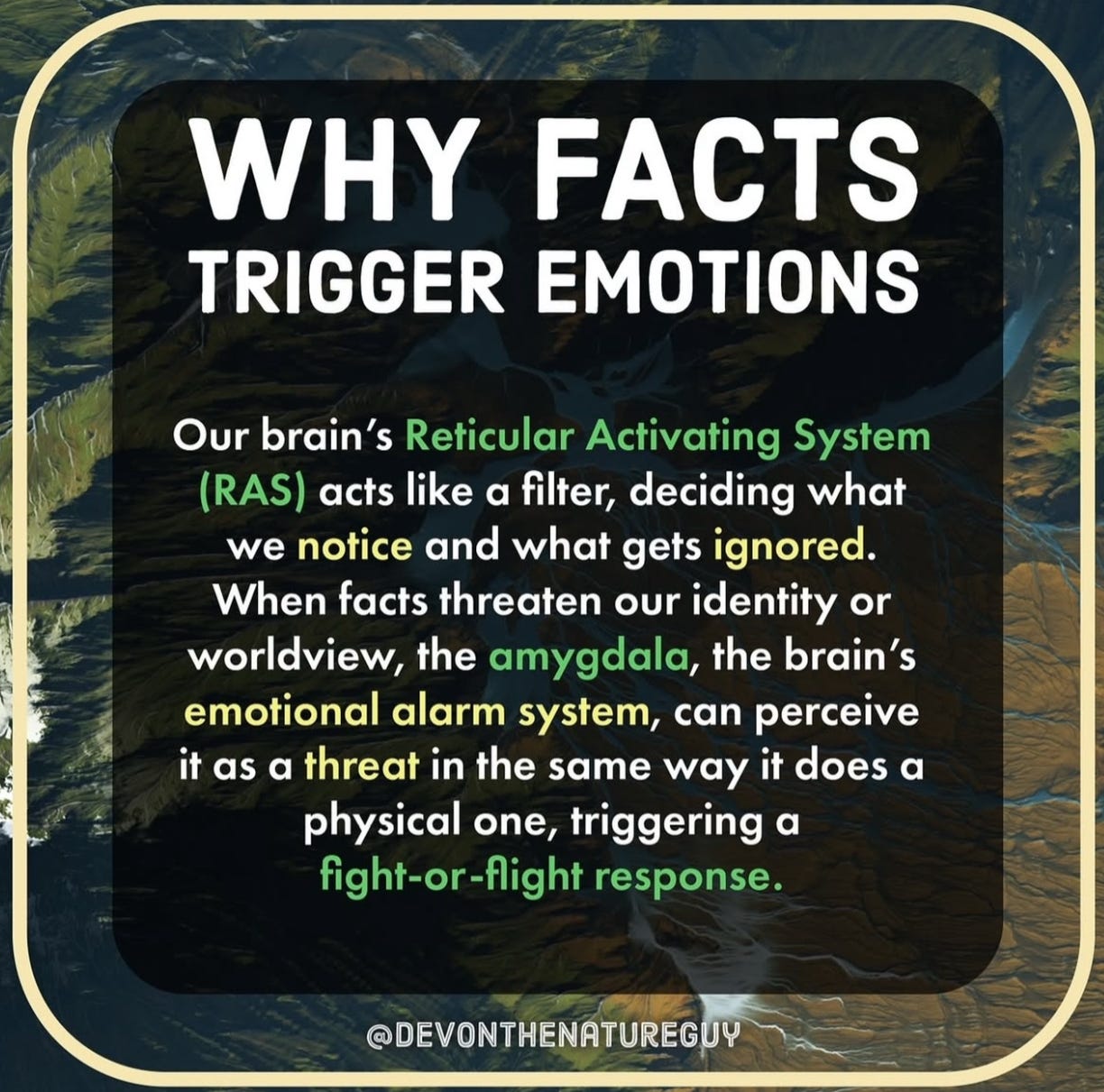
It’s called the Backfire Effect and @DevontheNatureGuy explains it really well. In short, when facts threaten our identity or worldview, the brain triggers an alarm that is as significant as our fight-or-flight response, Devon says. When that happens, good luck getting through to someone. Their brain has officially shut off any and all reasoning ability.
Devon continues that people process information through their beliefs (not outside of them), and facts don’t address the emotional or identity-based attachment to that belief. They feel personally attacked, and it is only made worse when the other person talks down to them or acts condescending because how in the world could someone be so dumb as to support this man?
Not to mention that facts are also often uninspiring and even when true, don’t always connect with a person’s experience. For example, the economy actually improved in several ways during Joe Biden’s presidency and unemployment decreased by more than 2%. But inflation did rise and the big issue was that people are feeling the strain in their wallets.
At a time when many people can barely afford rent or to feed their children, Trump honed in on how that makes people feel scared, helpless, and even guilty or ashamed that they can’t provide for their family.
Biden and Harris talked about facts like the U.S. economy grew by 12.6% in the last four years. Which one is going to resonate more? I can tell you that even just writing this made me think, yeah that’s totally how people would feel, while the stat doesn’t stir up any emotion whatsoever.
When you use clear, direct messaging, people know what to do and know how to act. When you can’t connect personally, you don’t inspire action. In her book, Harhut quotes Canadian neurologist Donald B. Calne: “The essential difference between emotion and reason is that emotion leads to action, while reason leads to conclusions.”
Another example is climate change: Democrats cite scientific reports, while Republicans call it a “hoax” that will destroy jobs, but vote for Trump and he will instead create jobs. It’s the one-two marketing punch: convince your audience that you understand what is painful for them (stir up their fear and/or anger) and then swoop in with the solution (give them hope).
Democrats try to use fear around this topic about the horrible things that are happening due to climate change and what the world could look like in 20 years, but fail to pair that with a compelling story or with an anecdote that actually conveys the feelings of what that might be like.
Trump is also great at connecting with people who feel misunderstood, overlooked, or like the underdog. It doesn’t matter that, in reality, he is on such a different wavelength that he has no actual idea what the average person is dealing with, but his team does a pretty good job convincing people he does.
And so they’re a tribe of underdogs, fighting for their identity, culture, and way of life against this other group of people who are trying to take that all away. When that narrative is consistent, clear, and repeated constantly (including by the media), it creates a sense of “truth” regardless of whether or not it actually is.
Biden’s — and later Harris’ — entire campaign was built around rejecting Trump and his ideals vs. sharing anything inspiring and personal with anyone. The Republican party has aligned themselves with nationalism, so-called American values, and personal freedom. These are all deeply held personal beliefs that people can latch onto. What do you think of when you think of the Democrats?
Ask 20 different people and you’ll get 20 different answers.
How to Actually Change Someone’s Mind
Now, I’m not suggesting the Democrats turn to fear-mongering, but they should at the very least balance facts with emotional storytelling. Don’t just talk about climate change, tell the story of someone who has lost their home or job because of a climate change related storm.
Don’t try to fluff up the fact that inflation is hurting people by saying that other economic metrics have improved, tell the story of real people who work two jobs but still can’t afford rent, while the richest Americans saw their wealth grow by 40% in the last year. Oh and by the way, Trump is one of those billionaires so how could he possibly understand the struggles of the person working two jobs?
When it comes to the individual, the key to having a productive conversation and maybe even changing someone’s mind is to:
Build trust to find common ground (maybe you both have kids or dogs, or grew up in a rural town)
Be patient, listen, and ask open-ended questions to understand their values, beliefs, and experiences (If someone prioritizes gun rights and freedom, don’t say, “We need gun control.” Instead, try, “We need responsible gun ownership to protect innocent lives.” Another example might be if you’re trying to convince someone why we should raise the minimum wage, instead of saying "Workers deserve more money,” try "Hardworking Americans should be paid fairly for their labor. No one working full-time should struggle to afford basic necessities.")
Use personal or relatable stories to connect with them and introduce the information
Give them an out so they can change their mind without feeling dumb or guilty (If applicable, you could say something like “I used to think the same thing, but then I learned this…” or “It’s totally understandable why you’d feel that way. A lot of new information has come out that changed my perspective.”)

What we have seen since Trump’s election is an emotive response that has resulted in protests, calling politicians demanding change, and maybe even some convincing Democratic wins in special elections (TBD). But this isn’t the Democrats doing, it’s the people rising up.
It’s the nearly inevitable swing back in the opposite direction after we’ve gone too far down the opposite path. If Democrats want to win the long-term game, they’re going to have to take a page from the Republican playbook.
Thank you for being a member of the Independent Thought Substack.
As of today, we have 10,066 readers of this publication!
Welcome to all of our new readers & thank you for being a part of our growing newsletter!
If you appreciated this post, please share it on social media or with a friend.
If you liked this post, please click the heart ❤️ button & 🔄 button. This helps Independent Thought get recommended more within Substack.
This newsletter is 100% reader-funded. Please become a paid subscriber to support our work.
I really enjoyed this article! You gave solid steps as well as brought a really great point to the conversation. I have been arguing with anyone I can since 2012 that the entire Republican platform is purely fear based and their supporters are so gripped by fear that they cannot think logically.
I do believe that Walz ran on and addressed the emotional needs of supporters & MAGA alike. The conversations he had with farmers were great! We definitely needed much more of that.
Harris is a prosecutor and a woman and I believe she may not have that emotionality and charisma due to being a woman of color in a male/(masculine characteristic) dominated field and in order to be taken seriously she couldn’t lean into it.
Democrats need to appeal to those without critical thinking skills, because the Republicans can just say anything and people believe them, it’s disheartening and sick.
This gave a lot to think about. I have to say I partially agree. I don’t think it’s because the democrats clung to just facts and statistics. I think that the democratic platform was just wildly out of touch with what matters to most Americans right now. Dems also did very little to address bigotry and racism tied to her opponents’s platform in a way that would rally people behind her. Neither did Biden. I’m sure these things were talked about in debates.. but let’s be real, the debates aren’t what got people to vote for trump either.